
Horizon Series 5: Exploring the Potential of Slag and Tailings Valorization
The Liability of Legacy Waste
Mining and metallurgical processes naturally generate massive volumes of tailings and slag. Historically, these secondary materials have been viewed purely as unavoidable waste.
Storing and managing these materials represents a significant operational expenditure (OPEX) and an ongoing environmental liability, often requiring long-term monitoring and complex containment strategies. At Rockburst Technologies, we are exploring whether the CoreBurst™ platform could offer a new pathway to reprocess these materials, theoretically turning hazardous waste streams into recoverable, revenue-generating assets.
The Bottleneck in Reprocessing Secondary Materials
Legacy tailings and slag stockpiles often contain valuable residual metals, but recovering them is notoriously difficult. These metals remain trapped within complex, hard-to-process mineral matrices.
The fundamental bottleneck lies in the mechanics of traditional comminution. Applying brute-force compressive crushing to these materials to liberate the trapped particles often results in severe over-grinding. This turns the material into an ultra-fine slime without cleanly separating the valuable metals from the waste matrix, making secondary recovery economically and operationally unviable.
The CoreBurst™ Hypothesis: Tensile Fracture for Slag
CoreBurst™ represents a fundamental shift in comminution by using transcritical CO₂ cycling to induce internal tensile fractures, rather than relying on external compression. We do this by exploiting the porosity and natural tensile weakness of rock, which is 10 times lower than its compressive strength.
Because slag and tailings are highly heterogeneous, our working hypothesis is that this thermodynamic fracturing could preferentially target the weakened boundary layers between the trapped valuable metals and the surrounding waste matrix.
We are actively researching whether this selective comminution could cleanly liberate residual metals, such as copper, nickel, or precious metals, that conventional grinding leaves behind. While early batch testing on primary ores is promising, applying this mechanism to specific slag and tailings mineralogies is an active, ongoing area of our experimental roadmap.
The Vision: Transforming Waste into Revenue
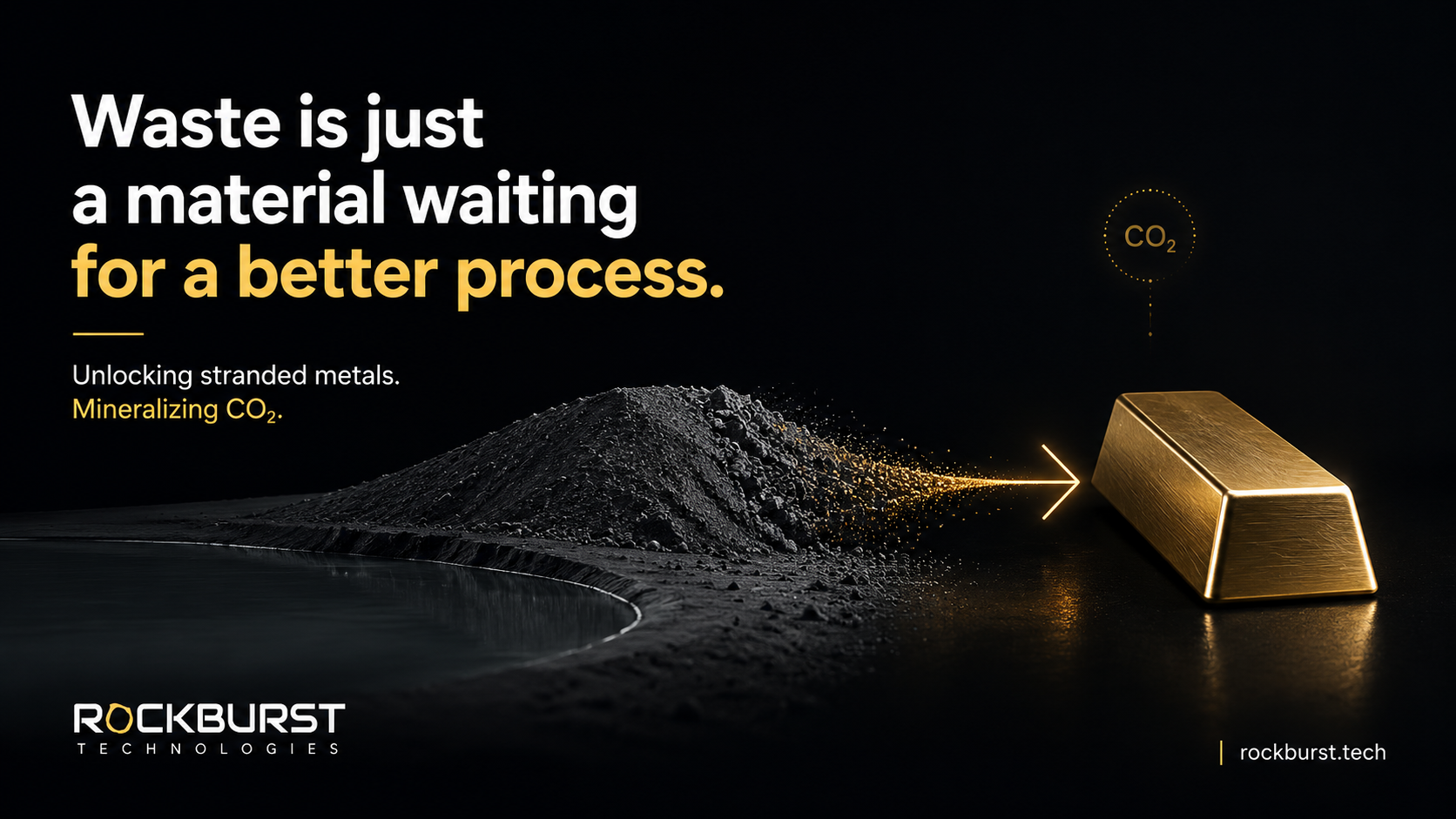
If our experimental programs successfully validate this selective liberation in secondary materials, the impact on mine economics and sustainability could be substantial. A viable pathway offers opportunities on three fronts:
Unlocking New Yield: Recovering stranded metals from legacy waste could open up entirely new revenue streams for operators, helping to directly offset processing OPEX.
Environmental Remediation: Cleanly separating out hazardous or reactive elements could theoretically reduce the overall toxicity and volume of the final waste requiring long-term containment.
The Carbon Bonus: Certain ore bodies, such as ultramafic rock, and industrial slags, particularly steel slag, are highly reactive. We are investigating whether processing these materials in a high-pressure CO₂ environment could simultaneously mineralize carbon, offering a dual benefit of metal recovery and permanent CO₂ sequestration.
Next Steps and Collaborative Testing
While the potential to redefine legacy waste is compelling, our primary focus remains on rigorous data validation. Rockburst Technologies is currently at Technology Readiness Level (TRL) 6, actively advancing toward a continuous-flow proof-of-concept.
Industry Partnership: Are you managing complex slag stockpiles or legacy tailings? We are actively seeking mining operators to supply secondary material samples for collaborative batch testing. Connect with our engineering team at info@rockburst.tech.
Strategic Investment: We are currently raising a $2M CAD Seed Round to fund the engineering of our continuous-flow unit. Reach out to info@rockburst.tech to learn more about our capital momentum.
