
Horizon Series 4: Anticipating the Impact of Tensile Comminution on Energy Logistics
The Remote Mining Challenge
As the global energy transition accelerates the demand for critical minerals, new deposits are increasingly being discovered and developed in remote, off-grid locations. However, operating these isolated mines requires immense amounts of power. Traditionally, this demand is met by transporting thousands of liters of diesel fuel across complex, expensive, and carbon-intensive logistical supply chains.
At Rockburst Technologies, we are exploring whether our CoreBurst™ platform could dramatically lower the energy requirements of mineral processing. By investigating a fundamental shift in the physics of rock breakage, we are seeking a potential pathway for off-grid mines to detach from heavy diesel reliance and transition to renewable micro-grids.
The Bottleneck of Brute Force
To understand the energy challenge of remote mining, we must look at the comminution circuit. Crushing and grinding rock is the most energy-intensive process in the industry, accounting for up to 4% of global electrical energy consumption.
The core issue is a mechanical flaw: traditional grinding relies on brute-force compressive crushing. Because rock is highly resistant to compressive stress, this method is fundamentally inefficient, wasting massive amounts of energy as heat and noise. This incredibly high baseline power demand makes it exceedingly difficult and capital-intensive to power remote comminution circuits entirely with intermittent renewables, like solar or wind, paired with battery storage.
The CoreBurst™ Hypothesis: Tensile Fracture vs. Compression
We are actively investigating a completely different approach. The CoreBurst™ technology uses pressurized CO₂ to fracture rock from the inside out, exploiting its natural tensile weakness—which is 10 times lower than its compressive strength.
Our laboratory-demonstrated progress shows significant promise. By shifting from compressive crushing to thermodynamic tensile fracture, our batch testing data fed to a scale up model indicates the potential for a 40% to 70% reduction in specific energy consumption compared to traditional grinding methods, for some ores.
While these batch-scale energy reductions projections are compelling, it is important to note that we are currently advancing our engineering roadmap to validate these efficiencies at scale.
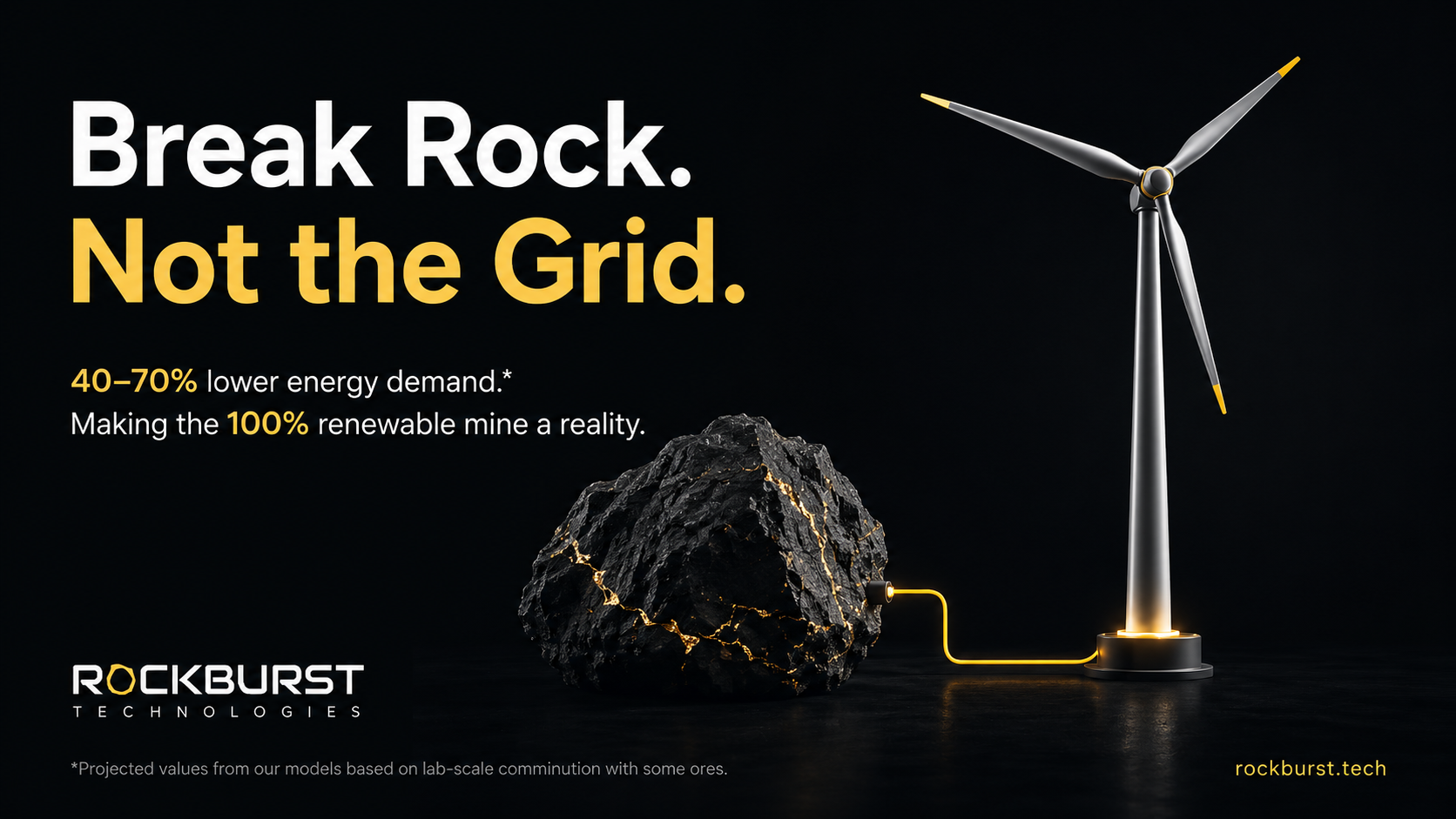
The Vision: Rewiring the Off-Grid Power Model
If our experimental continuous-flow programs successfully validate this energy reduction at commercial scale, the implications for remote operators could be transformative. A viable pathway offers opportunities to rewire the off-grid power model on several fronts:
Downsizing the Power Plant: A modeled 40% to 70% drop in comminution energy demand means the overall power generation requirements for a mine site would be drastically reduced.
Unlocking Renewables: This significantly lower energy threshold could make renewable micro-grids and battery storage economically and operationally viable for heavy mineral processing operations.
Slashing OPEX & Emissions: Reducing or completely eliminating the need to truck in diesel fuel lowers operational expenditures, protects operators from volatile fuel prices, and significantly curtails both Scope 1 and Scope 2 emissions.
Next Steps on the Path to Continuous Flow While the vision of a diesel-free, off-grid mine represents an exciting horizon, our focus remains strictly on rigorous research and engineering execution. Rockburst Technologies is currently at Technology Readiness Level (TRL) 6, and we are actively advancing our capabilities from batch validation to a continuous-flow proof-of-concept prototype.
Industry Partnership: Are you managing remote operations or exploring ways to reduce comminution energy intensity? We welcome engagement with operators to explore collaborative testing opportunities on target ores. Reach out to our team
Strategic Investment: We are currently raising a $2M CAD Seed Round to fund the engineering of our continuous-flow unit. Connect with us directly to learn more about our capital momentum.