
Horizon Series 1: The Carbon-Negative Mine
The Vision: From Planetary Emitter to Planetary Carbon Sink
For decades, resource extraction has been defined by a heavy industrial footprint. But as the world races to secure the critical minerals required for the global energy transition, the mining operations of the future must undergo a paradigm shift: they must transition from massive emitters into planetary carbon sinks.
In the carbon-negative mine, the facility utilizes Direct Air Capture (DAC) systems to pull CO₂ directly from the atmosphere. However, instead of simply burying this captured CO₂ or treating it as a waste product, the mine utilizes it as an industrial workhorse. By replacing carbon-intensive mechanical rock-crushing with thermodynamic fracture, the captured atmospheric CO₂ is injected directly into the ore.
This process fundamentally reverses the environmental impact of traditional grinding. The thermodynamic expansion shatters the rock along its natural grain boundaries, drastically lowering the mine’s energy profile while permanently sequestering the captured CO₂ within the generated tailings (waste rock). In doing so, resource extraction is transformed into a gigaton-scale Carbon Dioxide Removal (CDR) mechanism.
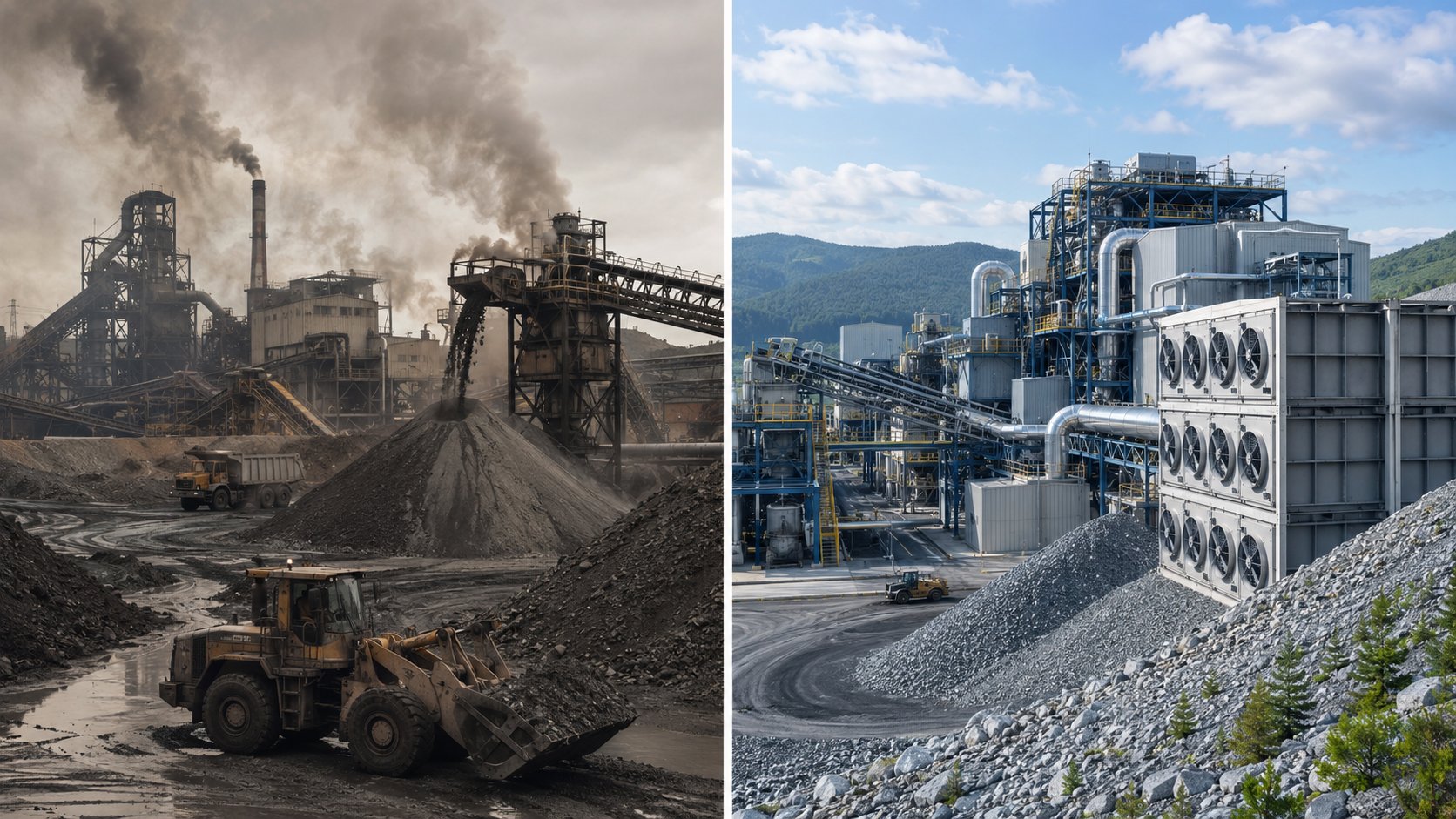
The Execution: Bridging the Gap to Commercial Reality
A vision without execution is just science fiction. The industrial reality is that the global mining sector currently consumes up to 4% of total global electrical energy, driven primarily by the brute force of mechanical grinding.
To achieve the vision of a carbon-negative mine, this thermodynamic rock-crushing process must be proven at an industrial scale. CoreBurst™ is currently bridging that exact gap.
At our current laboratory scale, compared against industry-standard Ball Mills processing Canadian ultramafic nickel ore, the CoreBurst™ mechanism delivers unprecedented metrics:
Energy Reduction: Modeled potential to reduce rock-crushing energy consumption by 40% to 70%.
Permanent Sequestration: Potential to permanently mineralize up to 160 kg of CO₂ per tonne of specific ultramafic ores (like nickel).
To move these metrics from batch testing to a commercial reality, Rockburst is raising a $2.0M CAD Seed Round to fund the critical first step of our deployment.
Rather than jumping blindly into pilot construction, this capital directly de-risks the scale-up process through a calculated 3-phase roadmap:
Phase I (2026) - Pilot Design: We will build a continuous-flow PoC prototype. This continuous proof-of-concept serves as our testing ground to test mechanisms, allowing us to learn, adapt, and deliver the exact data required to finalize the design of our commercial pilot.
Phase II (2027) - Pilot Build: Construction of the 50 kg/hr, continuous-mode pilot plant.
Phase III (2028) - Pilot Operations: Launching the pilot for a 1-year operational run. The final outcomes will definitively validate energy savings, gigaton decarbonization potential, and enhanced mineral liberation to inform scale-up.

The Data Drop
Download the CoreBurst™ Decarbonization & Investment Data Sheet Access the exact lab-demonstrated benefits, Scope 3 elimination data, and Marginal Abatement Cost (MAC) calculations driving our seed round.
Join the CoreBurst™ Deployment
Investment Help us bridge the gap to continuous flow. Participate in our $2.0M Seed Round to fund the continuous-flow PoC prototype and unlock an immediate $1.0M in non-dilutive matching capital.
Fill out the form below to request access to our Investor Data Room and Pitch Deck.
Strategic Partnership Are you an operator processing ultramafic ores? Partner with us to test your rock, secure tax-compliant "Green Nickel," and unlock your mine's CDR potential.
Fill out the form below to connect directly with our team.
