
Grinding Rock Wastes 4% of Global Electricity. We're Using Smart Physics to Solve It.
The global energy transition depends on a massive supply of critical minerals like copper, nickel, and lithium. But this creates a powerful paradox: the very industry we need to enable decarbonization is one of the world's most energy-intensive.
Comminution—the process of crushing and grinding ore—is the single biggest energy consumer in mining. It's an industrial process so vast that it accounts for up to 4% of all global electricity consumption.
For over a century, we’ve relied on brute-force compression to smash rocks. This method is inefficient, costly, and a significant barrier to meeting our climate goals.
At Rockburst, we're not fighting rock; we're using its own weakness against it. Our CoreBurst™ technology represents a new paradigm in comminution.
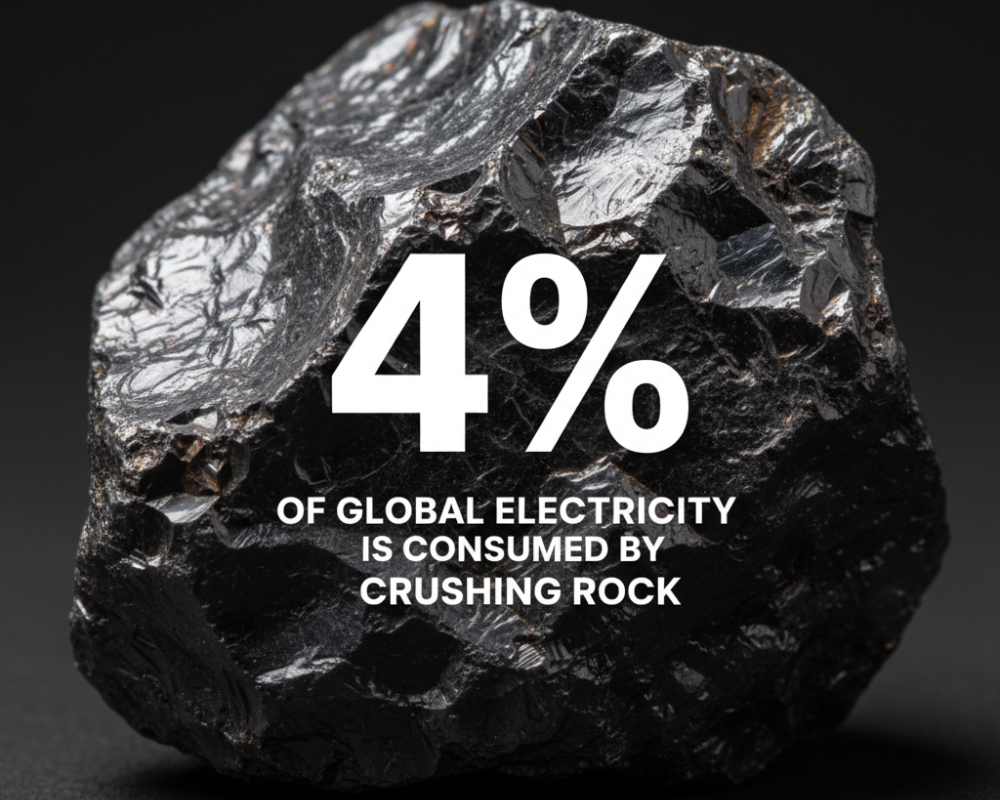
A significant portion of the world's energy is spent on traditional rock crushing.
The "Aha!" Moment: Exploiting Tensile Weakness
Here's the core scientific principle: rock is 10 times weaker under tensile stress (being pulled apart) than it is under compressive stress (being crushed).
Instead of crushing a rock from the outside, we break it from the inside. Our 3-minute explainer video shows this principle in action.
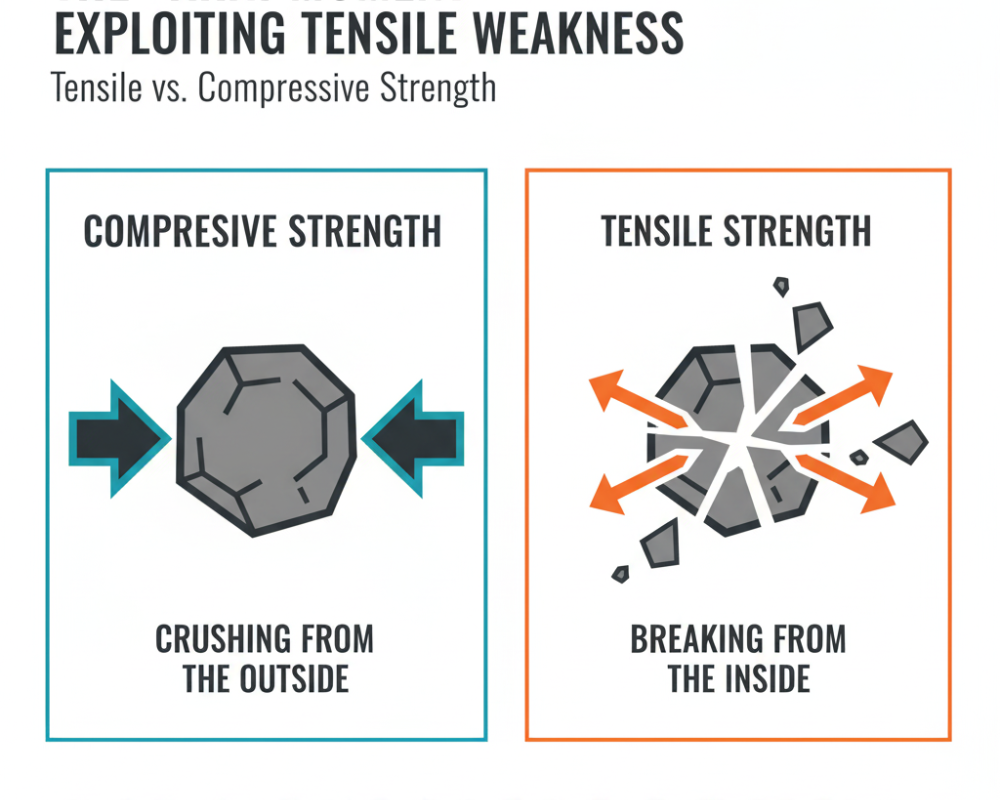
Rock is significantly weaker under tensile (pulling apart) stress than compressive (crushing) stress.
The CoreBurst™ Process (As Seen in the Video)
As the video shows, CoreBurst™ uses carbon dioxide as a powerful working fluid to fracture rock from within. The process, known as transcritical CO₂ pulverization, involves two key stages:
Stage 1: Pressurization Ore is placed in a pressure vessel and exposed to carbon dioxide in its "supercritical" state. In this state, CO₂ has the high density of a liquid but the low viscosity and zero surface tension of a gas. This allows it to rapidly penetrate deep into the rock’s natural micro-fractures, pores, and grain boundaries.
Stage 2: Rapid Depressurization We then rapidly release the pressure. The supercritical CO₂ trapped inside the rock expands, generating powerful internal tensile forces that break the ore apart from the inside out.
Why This Changes Everything
This new mechanism unlocks a cascade of benefits that address mining's core economic and environmental challenges:
Benefit 1: ~50% Energy Reduction By exploiting tensile weakness, our projections—based on lab-scale performance data—indicate an energy reduction of approximately 50% compared to conventional milling circuits for some ores.
Benefit 2: Eliminates Steel Media The process requires no consumable steel grinding media. This removes a major operational expenditure and a significant source of Scope 3 emissions from the mining value chain.
Benefit 3: Superior Mineral Liberation Preliminary evidence suggests the fractures preferentially propagate along natural grain boundaries. This "selective comminution" can liberate target minerals more cleanly, potentially improving recovery rates and reducing downstream processing needs.
The Bigger Picture: From CO₂ "Use" to "Processing with Air"
This isn't just about efficiency; it's about circularity. We call this virtuous cycle "Processing Critical Minerals with Air".
The CO₂ used in the CoreBurst™ system can be sourced from captured industrial emissions or from Direct Air Capture (DAC) technology.
But the system doesn't just use CO₂—it also sequesters it. The high-pressure CO₂ environment, combined with the continuous creation of fresh, reactive mineral surfaces, accelerates natural carbon mineralization. This process permanently and safely locks a portion of the CO₂ into the mine tailings as stable carbonate minerals.
This synergy transforms CO₂ from a liability into permanently sequestered rock and creates a pathway for "carbon-negative" critical minerals.
Join Us on the Path to Commercialization
CoreBurst™ is a fundamental shift in how we process resources, making it cleaner, cheaper, and more sustainable.
We are currently at Technology Readiness Level (TRL) 5 and are focused on advancing to the pilot stage.
To make this vision a reality, we are actively seeking strategic investors and industry partners to help fund and deploy our first commercial-scale pilot unit.
Contact us to learn about our technology and investment opportunities.