
Horizon Series 3: Exploring the Potential of CoreBurst™ for Construction & Demolition Waste Recycling
Introduction: The Decarbonization Imperative
The global cement industry is indispensable to infrastructure, but its substantial contribution to global CO₂ emissions, estimated at 7-8% annually, necessitates a profound transformation. Achieving deep decarbonization requires innovations that offer integrated, economically viable solutions beyond incremental improvements.
At Rockburst Technologies, we are exploring whether the CoreBurst™ platform could offer a meaningful opportunity to address commercial and climate imperatives simultaneously. By investigating new approaches to concrete recycling and closed-loop carbon utilization pathways, we are working toward establishing technologies that may one day help tackle the industry's most stubborn bottlenecks.
The Bottleneck in Concrete Recycling
The management of Construction & Demolition Waste (C&DW) is a key focus for circular economy initiatives. However, a significant mechanical challenge hinders current processes: conventional recycling often struggles to fully separate the hardened cement paste (HCP) from the aggregates.
Because traditional mechanical grinding relies on compressive crushing, it frequently fails to cleanly separate these components, resulting in recycled concrete aggregates (RCA) with inferior properties. This downgrade often limits their reuse in high-value applications.
The Hypothesis: Applying Tensile Fracturing to C&DW
We have gathered data demonstrating that CoreBurst™ exploits the tensile weakness of standard and ultramafic rocks. Our next experimental frontier is investigating if these same comminution principles can be effectively applied to Construction & Demolition Waste.
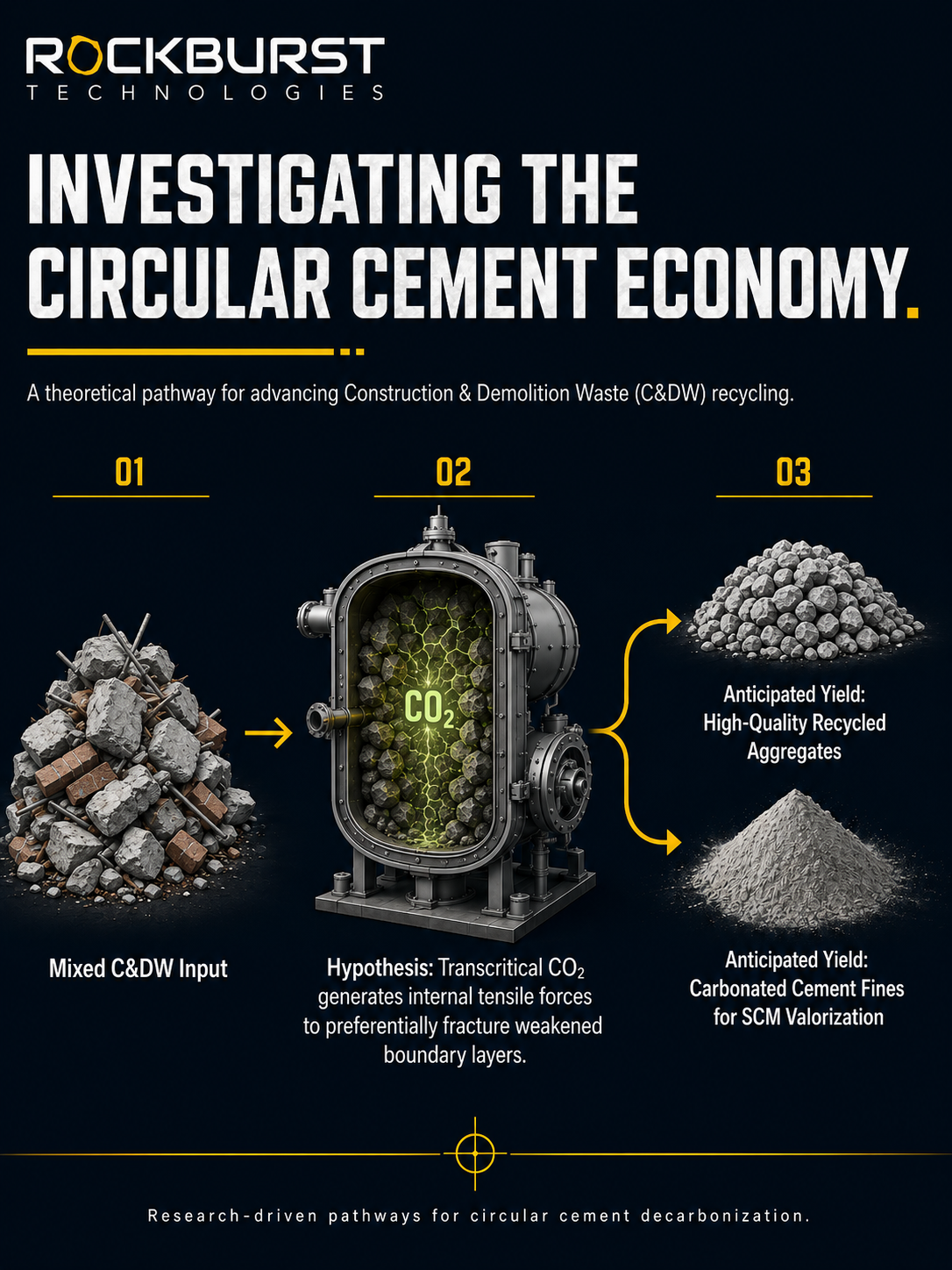
CoreBurst™ represents a fundamental departure from conventional comminution by using pressurized CO₂ to generate intense internal tensile forces that fracture the material from within. Because concrete aggregates are bound by hardened cement paste, our working hypothesis is that our transcritical CO₂ process could preferentially fracture along the HCP to aggregate binding contact points.
We are currently researching whether this internal tensile fracturing might achieve a much cleaner separation of HCP from aggregates. If validated, this theoretical approach shows potential to yield high-quality recycled sand and gravel suitable for replacing virgin aggregates in new concrete production.
Investigating CO2 Mineralization
Beyond physical separation, our research also focuses on the potential for integrated carbon removal. When processing C&DW, we knowthat our high-pressure CO₂ environment can react with residual calcium-bearing phases in the cement paste.
Rockburst is actively engaging in experimental programs with industry partners to quantify the efficiency and extent of this mineralization within the CoreBurst™ process, with the goal of forming stable calcium carbonate minerals.
If these experimental programs yield positive results, this process could permanently sequester CO₂ within the recycled material while potentially improving the quality of the recovered HCP in the recycled concrete fines (RCF). If successfully recovered and carbonated, these recycled concrete fines (RCF) could represent a promising supplementary cementitious material (SCM).
The Vision: What a Viable Pathway Could Mean at Scale
If our experimental programs validate this theoretical pathway, the implications for the global cement industry could be substantial. By addressing the mechanical limitations of current recycling methods, a viable CoreBurst™ process shows potential to impact the sector on three fronts:
Transforming Waste into a Carbon Sink: The cement & concrete sector is responsible for an estimated 7-8% of annual global CO₂ emissions. An integrated mineralization process shows potential to turn construction and demolition waste from an environmental liability into a scalable carbon storage asset.
Accelerating the Circular Economy: A viable method for cleanly separating aggregates from hardened cement paste could enable high-quality recycled sand and gravel to replace virgin materials at higher percentages. Furthermore, utilizing carbonated recycled concrete fines as supplementary cementitious materials could allow for greater clinker substitution, lowering the carbon intensity of new cement.
Unlocking New Economic Value: The market for carbon removals is projected to reach between $0.3 trillion and $1.2 trillion annually by 2050. A proven CoreBurst™ application in this sector offers opportunities for operators to unlock new revenue streams through verified carbon credits and command premium pricing for low-carbon materials.
Collaborate on Our Experimental Roadmap While these theoretical applications in circular cement represent an exciting horizon, our focus remains firmly on rigorous research progress and experimental validation. Rockburst Technologies is currently at Technology Readiness Level (TRL) 6, and we are actively advancing our testing capabilities.
Industry Partnership: Are you managing C&DW or exploring circular cement pathways? We welcome engagement with cement industry leaders to explore collaborative testing opportunities.
Strategic Investment: We are actively seeking strategic investors to help fund our ongoing research and deploy our first commercial-scale pilot unit.